
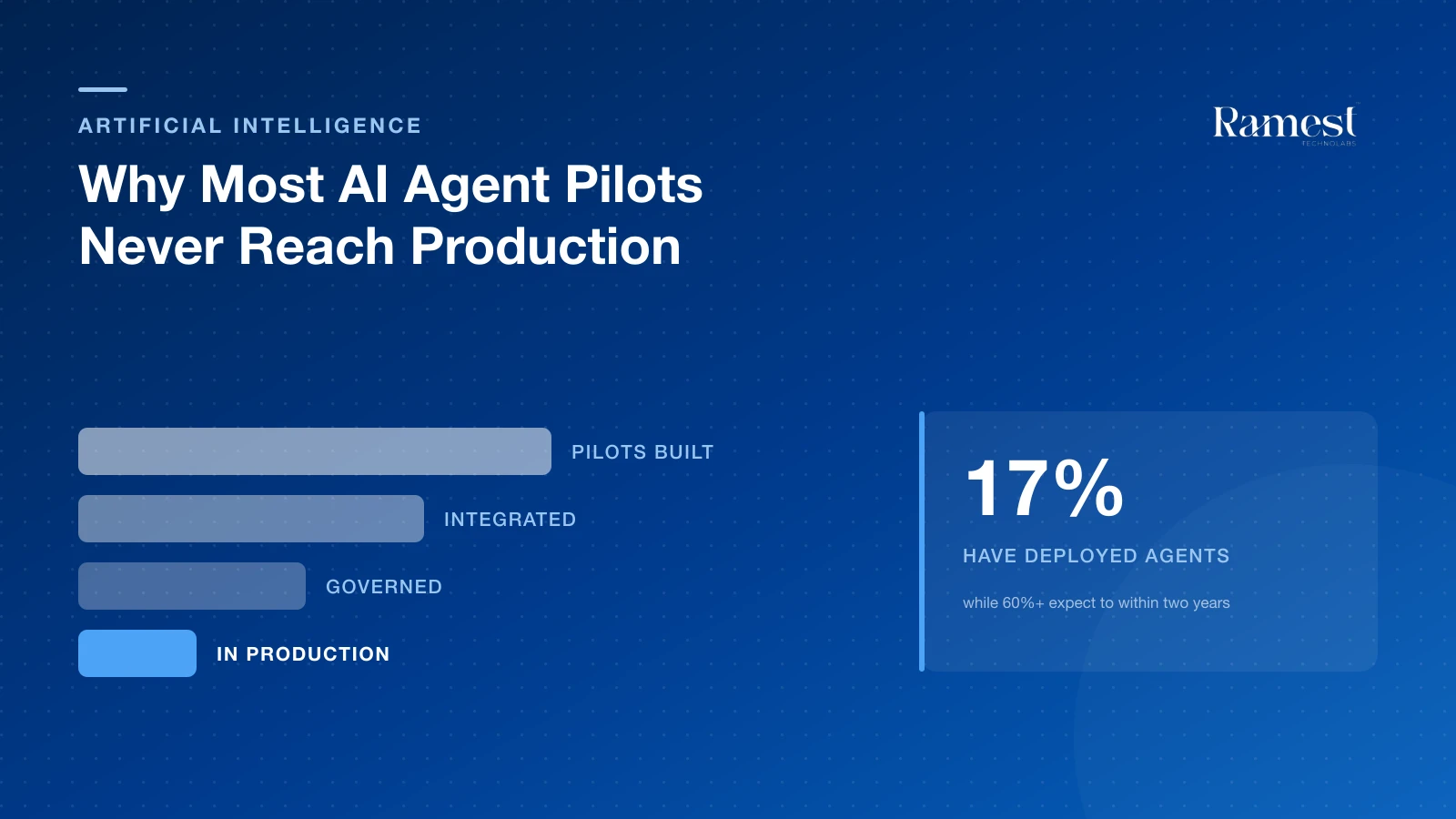
AI agents — software that can plan, call tools and take actions on its own — are the most talked-about idea in enterprise technology. Almost every company we speak with has built a pilot. Very few have one running in production. Across the teams we talk to, only around 17% have actually deployed agents to real users and real systems, even though most expect to within the next two years.
The gap is not about model quality. Today's models are more than capable. Pilots stall at the same three steps on the way from demo to production: integration, governance and reliability. This article explains why, and what the teams that make it do differently.
The pilot-to-production funnel
Think of agent adoption as a funnel with four stages. Each stage loses most of the projects that entered it:
- Pilots built. A demo works in a notebook or a sandbox, on hand-picked examples. This is where nearly everyone is.
- Integrated. The agent is connected to real systems — CRM, ticketing, ERP, email — with real permissions and real data.
- Governed. Security, legal and compliance have signed off: access is scoped, actions are logged, and there is a clear owner.
- In production. Real users rely on it daily, it is monitored, and the business can measure its value.
Most pilots never leave stage one. Here is why.
Reason 1: The demo was built on the easy 80%
A pilot is usually tested on clean, typical examples. Production traffic is not typical. Customers write vague requests, documents are incomplete, systems return errors, and edge cases arrive every day. An agent that succeeds 85% of the time looks impressive in a demo — and is unusable when the remaining 15% means a wrong refund, a lost order or an email sent to the wrong customer.
What works: build an evaluation set from real historical cases, including the messy ones, before you build the agent. Measure success rate, failure types and cost per task on every change. If you cannot measure it, you cannot ship it.
Reason 2: Integration is harder than the AI
An agent is only useful if it can act — read the order, update the ticket, schedule the call. That means authentication, API limits, data mapping, error handling and retries across systems that were never designed for an autonomous caller. In our experience this integration work is often larger than the AI work itself, and pilots rarely budget for it.
What works: start with read-only access and a small, well-defined set of tools. Wrap each system in a narrow, tested interface rather than giving the agent broad API access. Add write actions one at a time, each with its own tests.
Reason 3: Nobody can sign off on it
Security and compliance teams ask reasonable questions that pilots cannot answer. What data can the agent see? What actions can it take without a human? How do we audit what it did? What happens if someone tries to manipulate it through a prompt? Under data-protection laws such as India's DPDP Act, personal data processed by an agent needs the same purpose limits, access controls and retention rules as any other system.
What works: treat governance as a feature, not a gate. Give the agent its own identity with least-privilege permissions, log every tool call and decision, require human approval for high-impact actions, and document the data flows early so review is quick.
Reason 4: No owner and no metric
Many pilots are run by an innovation team, with no business owner who will be measured on the result. When the demo ends, nobody is responsible for taking it further. Without a clear metric — hours saved, tickets resolved, revenue recovered — there is no case for the extra investment production needs.
What works: pick a use case owned by a business team, agree on one success metric and a target before building, and report against it from the first week.
Reason 5: Costs and reliability surprise everyone
Agents make many model calls per task: planning, tool calls, checking results, retrying. A task that costs cents in a demo can cost dollars at scale, and long chains of steps multiply the chance that one step fails. Latency grows too — users will not wait a minute for an answer they used to get in seconds.
What works: keep agent workflows short and structured. Use deterministic code for steps that do not need judgement, route simple steps to smaller and cheaper models, cache repeated work, and set hard limits on steps and spend per task.
A practical path to production
- Choose a narrow, valuable task with a clear owner and metric — for example triaging support tickets or drafting replies for human review.
- Build the evaluation set first from real cases, including the difficult ones.
- Start as an assistant, not an autopilot. The agent drafts, a human approves. Autonomy grows as measured accuracy grows.
- Integrate through narrow, tested tools with least-privilege access and full logging.
- Involve security and compliance from week one so sign-off is a formality, not a blocker.
- Monitor in production — success rate, cost per task, latency and escalations — and review failures every week.
The bottom line
Agent pilots fail for predictable reasons, and none of them are about the model. The teams that reach production treat an agent like any other critical system: scoped, tested, governed, owned and measured. Start smaller than you think, keep a human in the loop until the numbers say otherwise, and expand from a working foundation.
Have an agent pilot that is stuck, or planning one and want to avoid the usual traps? Talk to our team — we help companies take AI agents from demo to dependable production.