
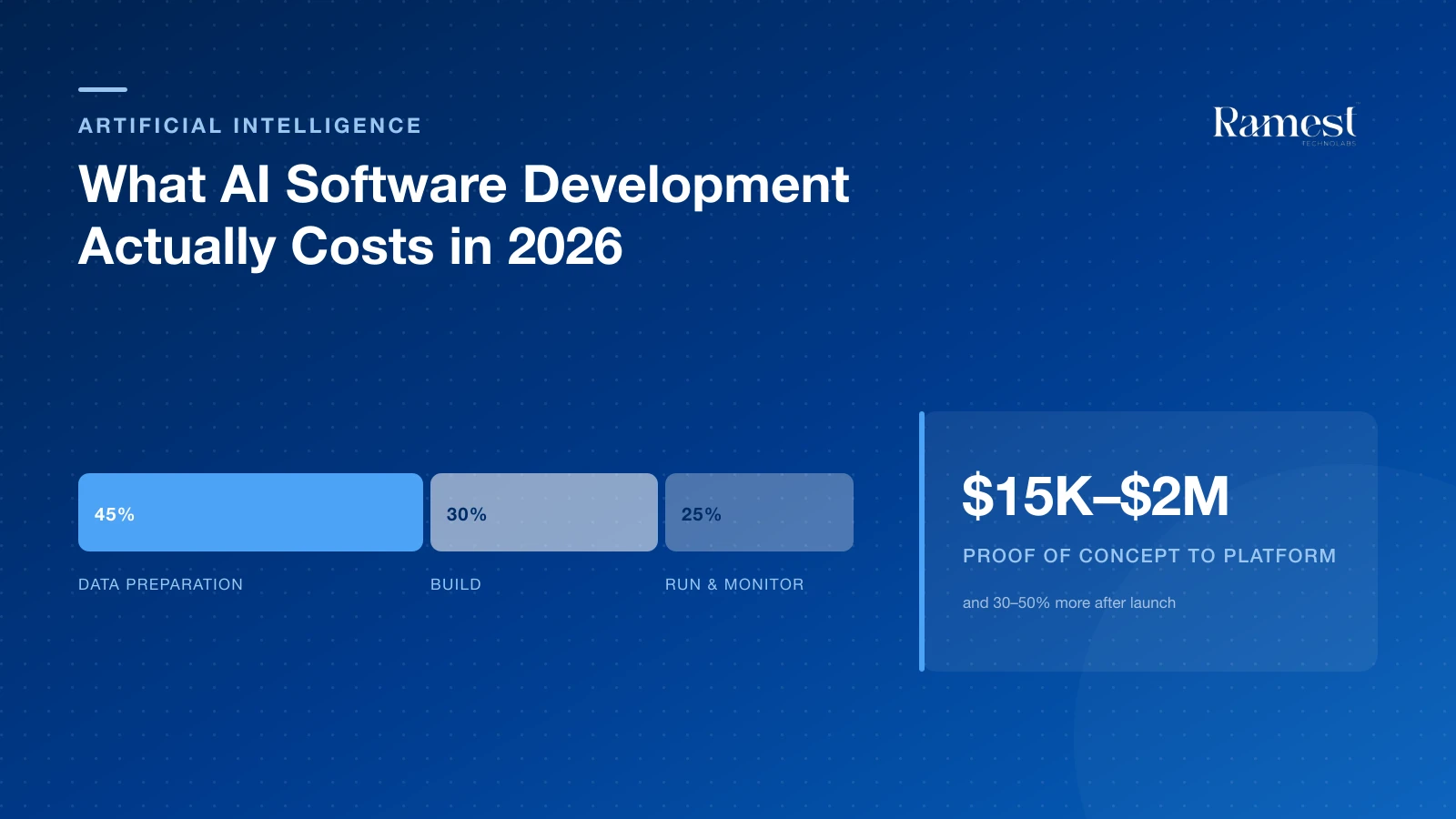
"How much will it cost?" is the first question every founder and CTO asks us about AI, and the honest answer — "it depends" — is also the least useful one. So here is a more useful answer. Across the AI projects we scope and build, budgets land anywhere from about $15,000 for a focused proof of concept to $2 million or more for a production platform, and most teams should plan for another 30–50% after launch to keep the system accurate, secure and affordable to run.
That range is wide because "AI software" covers very different things. This article breaks down where the money actually goes, what moves a project from one end of the range to the other, and how to spend less without shipping something that falls over in production.
Where the budget really goes
Most people expect the model to be the expensive part. In practice, it rarely is. When we look back at the projects we have delivered, the spend splits roughly like this:
- Data preparation — around 45%. Finding, cleaning, labelling, de-duplicating and securing the data the system depends on. This is the least glamorous work and the most common reason AI projects run over budget.
- Build — around 30%. Model selection or fine-tuning, prompt and retrieval design, the application around the model, integrations with your existing systems, and testing.
- Run and monitor — around 25%. Hosting, inference costs, evaluation pipelines, logging, guardrails, and the people who watch quality once real users arrive.
The takeaway: if your estimate is mostly "build", it is probably missing more than half of the real cost.
The four tiers of AI projects
1. Proof of concept: $15K–$50K
A narrow, time-boxed experiment — typically four to eight weeks — that answers one question: can this work on our data? Think a document-summarisation prototype, an internal chatbot over a single knowledge base, or a classification model tested on historical records. It uses off-the-shelf models, a small clean dataset and minimal integration. The goal is evidence, not a product.
2. Minimum viable product: $50K–$250K
A working feature in front of real users. This is where authentication, a proper user interface, integration with one or two core systems, basic evaluation and cost controls appear. Most customer-facing assistants, AI-powered search features and workflow automations sit in this band.
3. Production system: $250K–$800K
Multiple workflows, higher traffic and stricter requirements: role-based access, audit logs, data residency, uptime targets, and automated evaluation that catches regressions before users do. Retrieval-augmented generation over large document sets, agents that take actions in business systems, and fine-tuned models usually land here.
4. AI platform: $800K–$2M+
Shared infrastructure that many teams and products build on: model gateways, central evaluation and monitoring, governance, custom or fine-tuned models, and dedicated MLOps. Organisations reach this tier after several successful products, not as their first step.
What pushes the cost up
- Messy or scattered data. Data spread across spreadsheets, PDFs and legacy databases can double the data-preparation phase on its own.
- Accuracy requirements. Moving from "usually right" to "right 99% of the time" costs far more than the first 90% did — mainly in evaluation and human review.
- Integrations. Every system the AI must read from or write to adds design, security review and testing time.
- Compliance. Handling personal data under India's DPDP Act, GDPR or sector rules adds consent handling, retention policies, access controls and audit trails.
- Custom models. Fine-tuning or training your own model is justified in some cases, but it adds data, compute and specialist time compared with using a hosted model well.
Why budgets grow 30–50% after launch
AI systems are not "finished" at launch. Once real users arrive, several costs appear that a prototype never shows:
- Inference costs scale with usage. A feature that cost a few dollars a day in testing can cost thousands a month in production.
- Quality drifts. User behaviour changes, source documents change and model providers update their models. Without ongoing evaluation, accuracy quietly degrades.
- Edge cases surface. Real users ask questions no test set anticipated, and each class of failure needs a fix, a guardrail or a human fallback.
- Security and compliance continue. Access reviews, prompt-injection defences, incident response and data-retention obligations do not end at go-live.
Planning for this from day one is the difference between an AI feature that improves over time and one that is switched off after six months.
How to spend less without cutting corners
- Start with one measurable use case. Pick a problem with a clear metric — hours saved, tickets deflected, errors caught — and prove it before expanding.
- Invest in data early. A week spent understanding and cleaning your data saves months of debugging model behaviour later.
- Use hosted models first. Well-designed prompts and retrieval on a strong hosted model beat a custom model for most business problems, at a fraction of the cost.
- Build evaluation before features. An automated test set that scores quality on every change is the cheapest insurance against expensive regressions.
- Control inference costs. Cache frequent answers, route simple requests to smaller models, and set per-user limits before traffic grows.
- Plan the run phase. Budget for monitoring, model updates and support as a line item, not an afterthought.
The bottom line
AI software in 2026 can cost as little as a small web project or as much as a core business platform. The teams that get good value have three things in common: they start small with a measurable goal, they treat data as the main workstream rather than a side task, and they budget for the system's life after launch — not just the build.
If you are weighing an AI project and want a realistic estimate for your data, your systems and your compliance needs, talk to our team. We will tell you honestly which tier you are in — and whether a proof of concept should come first.