
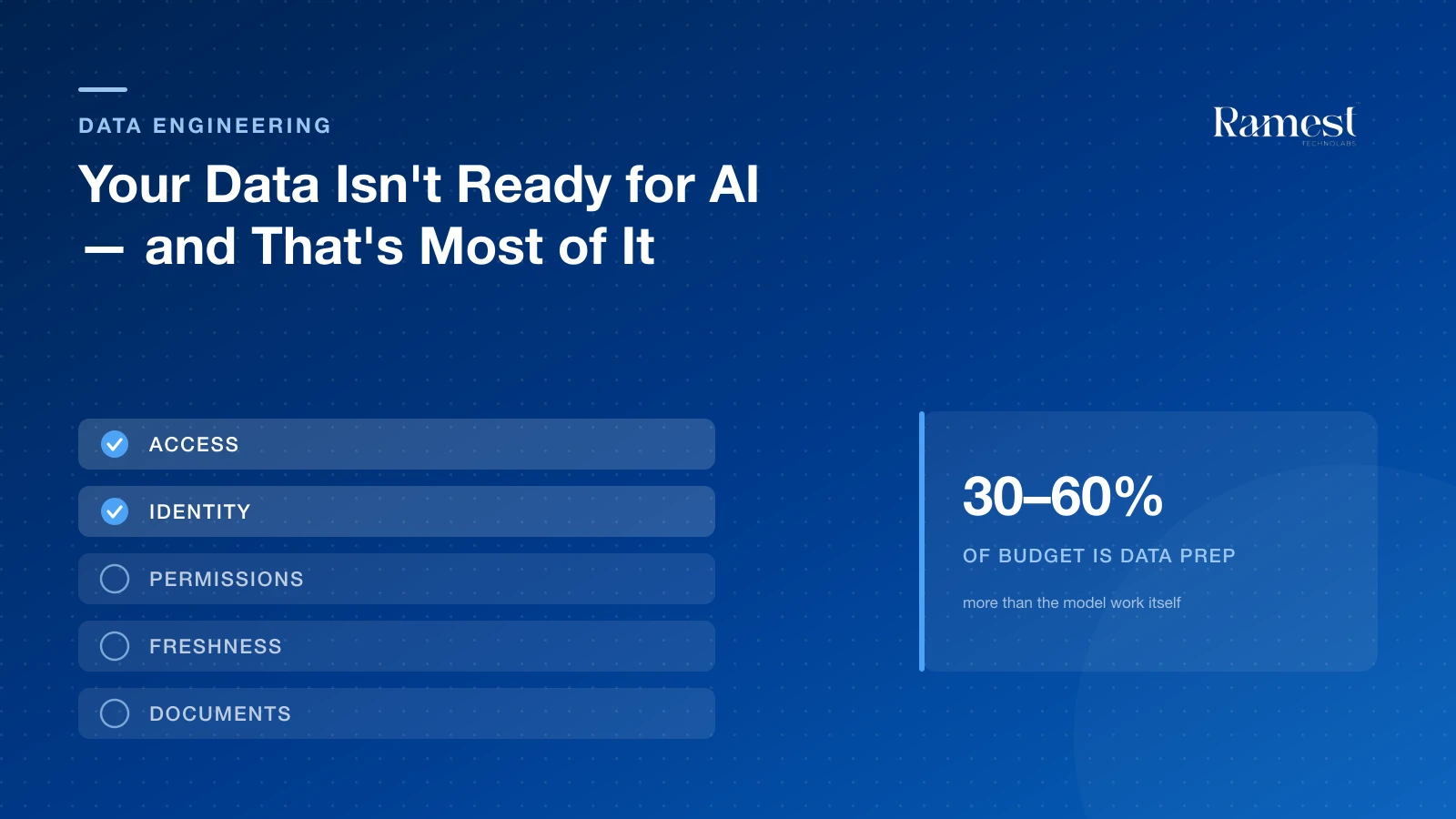
Most AI projects do not fail because the model is wrong. They fail because the data behind it is scattered, stale, locked away or quietly contradictory. In the AI projects we scope and build, data preparation typically takes 30–60% of the total budget — more than the model work itself. Teams that plan for this ship on time. Teams that do not discover it halfway through, when the demo that worked on a sample falls apart on real records.
The good news: data readiness is not a mystery. It comes down to five questions you can answer before a single line of AI code is written.
The five-point data readiness check
1. Access — can the system actually reach the data?
The first surprise in most projects is how hard it is simply to get the data out. Records live in legacy databases without APIs, in SaaS tools with export limits, in shared drives and in individual inboxes. Some sources can only be read by one person's account.
Ready looks like: every source the AI needs has a documented, automated way to read it — an API, a database replica or a scheduled export — owned by someone who will keep it working.
2. Identity — do records agree on who and what they describe?
The same customer appears as "Acme Pvt Ltd" in the CRM, "ACME" in billing and an email address in support. Products have different codes in inventory and in the website catalogue. An AI system that cannot tell these are the same entity will give confident, wrong answers.
Ready looks like: a clear key for each core entity — customer, product, employee, order — and a matching rule that links records across systems.
3. Permissions — does the AI respect who is allowed to see what?
This is the check most pilots skip and most security teams stop. If an assistant can search every document in the company, it can also reveal salary files, board papers or another client's contract to anyone who asks the right question. Under data-protection laws such as India's DPDP Act, personal data must also be used only for the purpose it was collected for.
Ready looks like: the AI inherits each user's existing access rights at query time, sensitive and personal data is labelled, and there is a record of which data the system is allowed to use and why.
4. Freshness — is the data current enough to trust?
An answer built on last quarter's price list or a policy document that was replaced in March is worse than no answer. Many knowledge bases are full of outdated drafts, duplicates and pages nobody owns.
Ready looks like: each source has a known update frequency, the AI indexes changes automatically, outdated content is archived, and answers can show when their source was last updated.
5. Documents — is unstructured content usable?
A large share of business knowledge sits in PDFs, scanned forms, slide decks and email threads. Scanned pages without text, tables that break when extracted, and long documents with no structure all reduce answer quality.
Ready looks like: documents are converted to clean, searchable text with their structure preserved — headings, tables, dates and authors — and split into sections the AI can retrieve precisely.
Why data work costs more than the model
Using a strong hosted model is now relatively cheap and fast. The expensive, slow part is everything that makes its answers correct for your business:
- Discovery — finding out which systems hold the truth, and which only look like they do.
- Cleaning and de-duplication — resolving conflicts that people have been working around manually for years.
- Integration — building reliable pipelines instead of one-off exports.
- Governance — labelling sensitive data, mapping permissions and documenting purposes.
- Evaluation data — assembling real examples with known correct answers, so quality can be measured.
None of this is wasted effort. The same clean, connected, governed data improves reporting, automation and every future AI project — not just the first one.
How to get ready without a year-long data programme
- Start from one use case, not the whole estate. Pick the AI feature you want first and list only the data it needs.
- Run the five-point check on those sources. Score each one — ready, partly ready or blocked — for access, identity, permissions, freshness and documents.
- Fix the blockers, accept the gaps. You rarely need perfect data. You need data that is good enough for the use case, with its limits known.
- Automate from day one. A manual export that works for the pilot becomes a production outage later. Build the pipeline once.
- Measure with real examples. Test the AI on real historical questions and records, including messy ones, before anyone relies on it.
The bottom line
If your data is not ready for AI, you are not behind — you are normal. Data readiness is most of the work in any serious AI project, and budgeting 30–60% of the effort for it is realistic, not pessimistic. Check access, identity, permissions, freshness and documents first, fix what blocks your first use case, and the model work that follows becomes the easy part.
Not sure how ready your data is? Talk to our team — we run a short data readiness assessment against your first AI use case and tell you exactly what to fix, and what you can safely leave for later.