
Ask five agencies what an AI project costs and you will get five ranges that do not overlap. That is not evasiveness — it reflects a genuine hundred-fold spread in scope — but it makes budgeting nearly impossible if nobody explains what moves the number.
So here is the honest version, with the parts most quotes leave out.
The headline ranges
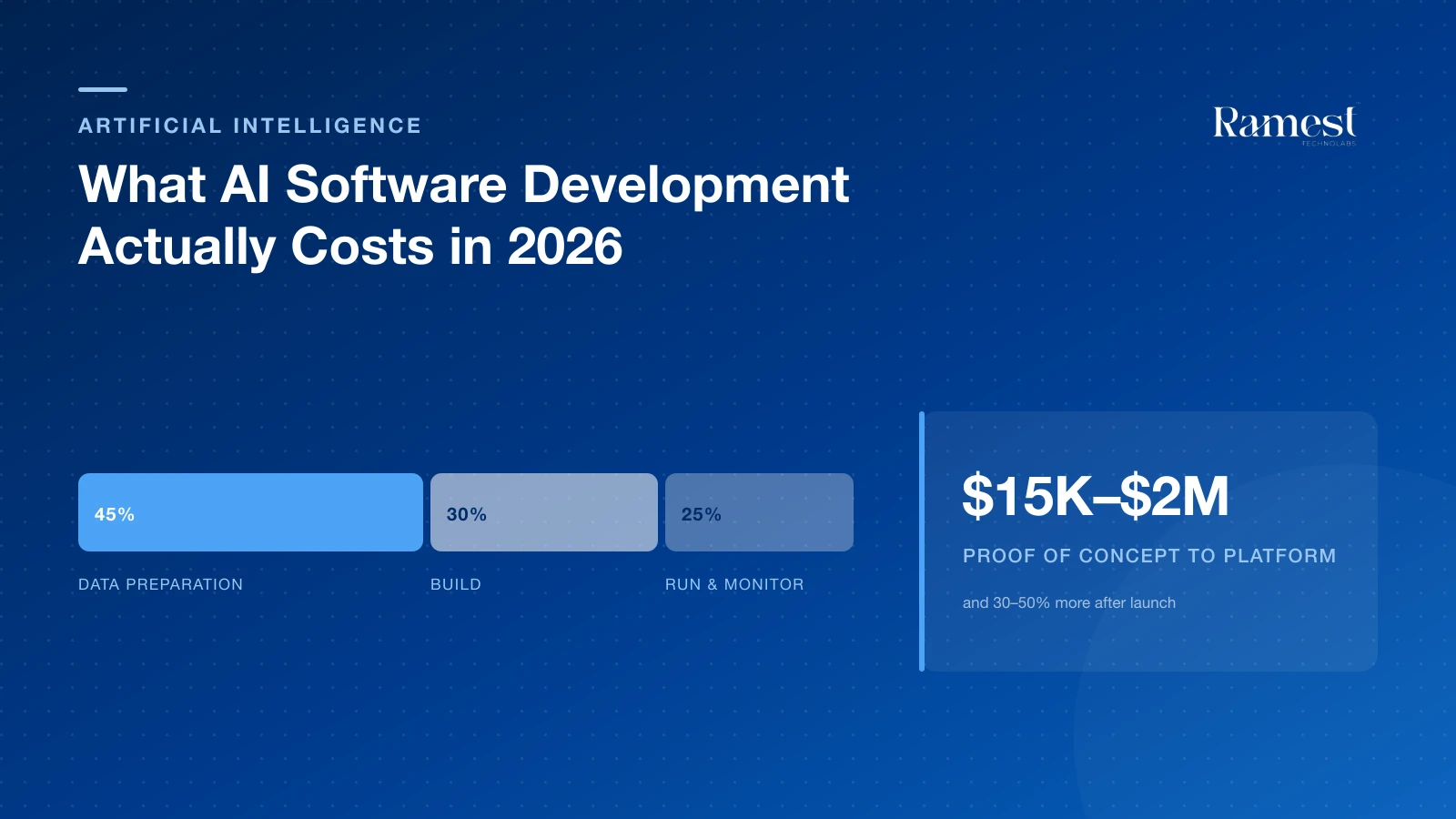
Published 2026 figures put AI software development between roughly $15,000 for a proof of concept and $2M for an enterprise platform, with outsourced AI app development commonly landing between $50,000 and $250,000. Those brackets are real, but on their own they are close to useless — the interesting question is which bracket you are in, and why.
Roughly how they map:
- $15K–$40K — proof of concept. One workflow, existing data, no production integration. The goal is a go/no-go decision, not a system. Worth doing when the uncertainty is "does this work at all"; a waste when the uncertainty is "will people use it".
- $50K–$250K — production feature. An agent, assistant or pipeline integrated with one or two real systems, with evaluation, monitoring and access control. This is where most useful business AI actually lands.
- $250K–$2M — platform. Multiple workflows, multiple data sources, an internal team to hand over to, and compliance requirements with names. Cost here is driven by organisational surface area more than by AI.
The cost nobody quotes: your data
This is the single most important line in this article. Data preparation consumes 30 to 60% of the total project budget — frequently more than the model work itself.
It is invisible in most proposals because it is invisible to the buyer at quoting time. You know your data exists. What you usually do not know until someone tries to use it:
- The same customer appears three times, with different IDs, across two systems
- The "notes" field contains most of the real information, unstructured, sometimes in more than one language
- Nobody can say which of two overlapping tables is authoritative
- Half the documents are scans, so before AI touches them something has to do OCR properly
- Permissions were never modelled, so there is no way to answer "may this user see this record?" programmatically
None of this is exotic. It is the normal state of a business that has been operating for a decade. But a quote that does not mention data preparation is not cheaper than one that does — it is the same work, discovered later, at worse timing.
The costs that arrive after launch
Retraining, drift monitoring, inference at scale and compliance add 30 to 50% beyond initial estimates. Concretely:
- Inference. Per-token pricing is trivial in a pilot with ten users and a real line item at ten thousand. Model this early — usage patterns, not user counts, drive it, and one chatty feature can dominate the bill.
- Drift. Your business changes; the model does not know. Without monitoring, quality decays silently and someone notices via complaints.
- Model deprecation. Providers retire versions. Budget for periodic re-validation against your eval set — this is cheap if you have one and expensive if you do not.
- Compliance. If you handle personal or regulated data, review is a real workstream, not a checkbox.
Rates by region, and what they actually buy
2026 outsourcing rates run roughly $120–$200/hour in North America, $90–$150 in Western Europe, $25–$45 in Eastern Europe, and $20–$35 in South Asia.
We are in Ahmedabad, so we are at the lower end of that spread, and it would be self-serving to pretend rate is the whole story. It is not. A cheaper team that needs three attempts to get the data model right costs more than an expensive one that gets it right once. The questions that predict outcomes better than rate:
- Have they shipped this type of system to production, not just built a demo?
- Do they ask about your data before quoting? If not, the quote is fiction.
- What happens after launch — who monitors quality, and under what arrangement?
- Will you own the code, the prompts, and the eval set?
How to scope so the budget holds
The approach we recommend, including to people who do not hire us:
- Pay for a short data assessment first. One to two weeks, fixed price. It converts the largest unknown into a known before anyone commits to a build. If a vendor will not do this, that is informative.
- Fund the proof of concept only if the decision is genuinely uncertain. If you already know the workflow is valuable, skip to a narrow production build — a PoC that everyone expects to succeed is an expensive delay.
- Set the running-cost ceiling during design. "This must cost under a fixed amount per month at 1,000 users" is an architectural input. Retrofitting it means rework.
- Budget 30–50% beyond launch for the first year. If you do not need it, excellent. Most teams do.
Common questions
Is a fixed price or time-and-materials better for AI work?
Fixed price works for bounded pieces — a data assessment, a PoC, an integration with a documented API. It works badly for anything where quality is defined by evaluation, because "good enough" is discovered rather than specified. A common structure is fixed-price discovery, then time-and-materials with a cap.
Why is the range so much wider than for normal software?
Because data quality varies more between companies than requirements do, and because part of the work is empirical. You cannot know in advance how many iterations retrieval quality will need.
Can we reduce cost by using an off-the-shelf tool?
Often, yes — and a good partner will tell you when the answer is "buy, do not build". The build case is usually about proprietary data or a workflow specific enough that no vendor targets it.
A realistic starting point
For most mid-sized companies, the sensible first cheque is a data assessment plus one narrow production workflow — well under the $250K bracket, and it produces something people use rather than a slide about potential.
If you want a grounded number for your situation, we do custom AI development and data engineering, and we will tell you when a project is not worth doing. Tell us what you are trying to build.